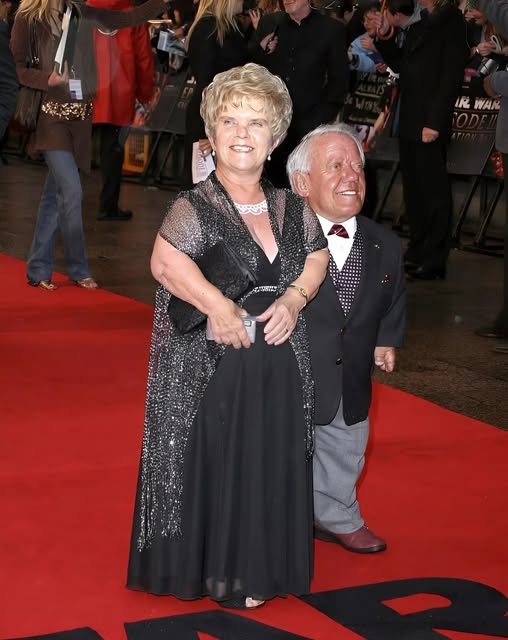
He stood just 112 centimeters tall—barely more than three and a half feet—and his wife was only slightly taller than him.
From the outside, many people saw only their height and the medical labels attached to it. Doctors warned them early on not to expect an easy path, especially when it came to building a family.
There were cautions, uncertainties, and quiet doubts spoken in clinical tones. Yet none of those warnings were strong enough to stand in the way of love, determination, and the desire to live a full, meaningful life.
This was the reality faced by Kenny Baker, a man whose physical stature never defined the scale of his talent, his resilience, or his impact on the world.
Born on August 24, 1934, in Birmingham, England, Kenny Baker grew up in a working-class family during a time when differences were rarely understood and often misunderstood.

From an early age, it was clear that he would not grow to an average height. He was diagnosed with a form of dwarfism, a condition that shaped his physical body but never limited his ambitions.
In an era with far fewer accommodations and far less awareness, Baker learned quickly that survival depended on adaptability, confidence, and humor.
Long before he became a familiar name to film audiences around the world, Kenny Baker found his place in entertainment through live performance.
As a teenager and young adult, he worked in circuses, carnivals, and traveling shows, environments that demanded stamina, timing, and a strong connection with audiences.
These early years were not glamorous, but they were formative.
On small stages and under temporary tents, Baker learned how to command attention, how to move precisely, and how to turn what others saw as a limitation into a professional strength.
Importantly, these experiences taught him discipline. Circus work required exact movements, physical endurance, and teamwork.
Every performance was a lesson in awareness—of space, of rhythm, and of audience reaction.
These skills would later become essential in a role where expression had to be conveyed without words or facial visibility.
Kenny Baker’s career gradually transitioned into film and television, where his size made him uniquely suited for certain roles during a time when practical effects were the standard.
He appeared in several productions throughout the 1960s and 1970s, including musical films and fantasy projects.
But nothing could have prepared him—or anyone else—for the role that would define his legacy.
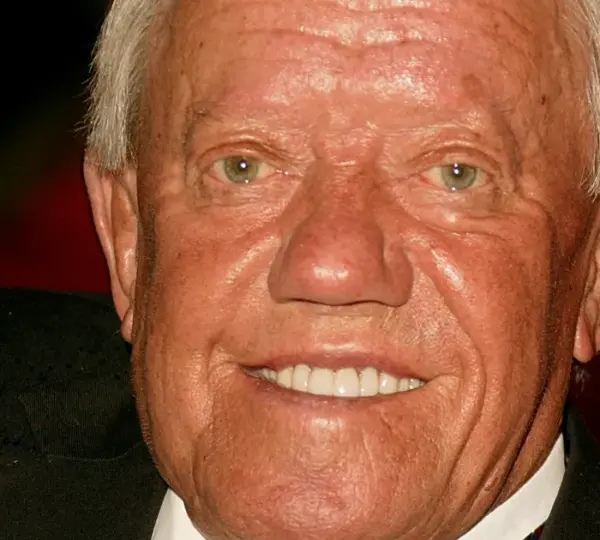
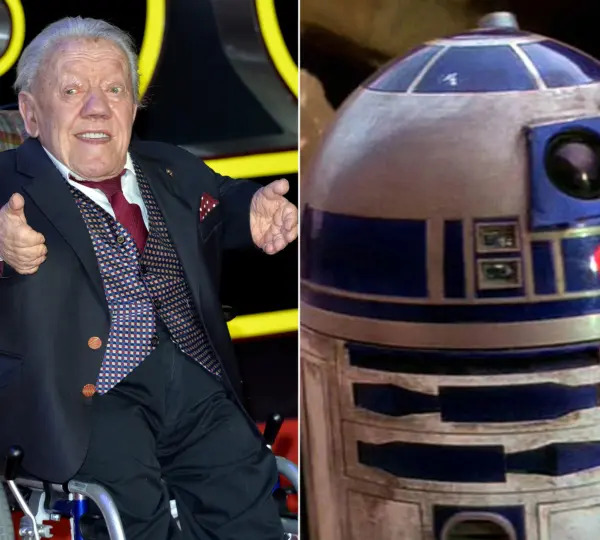
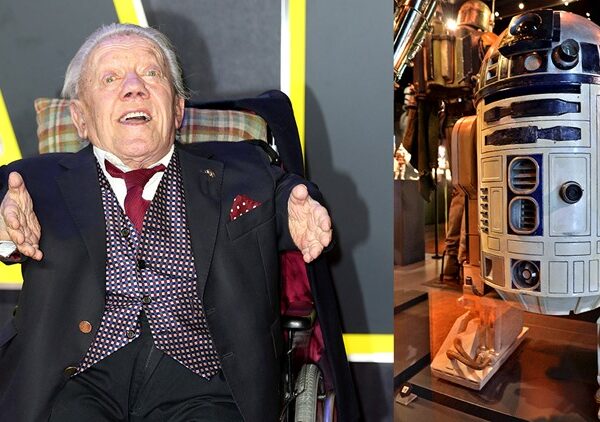
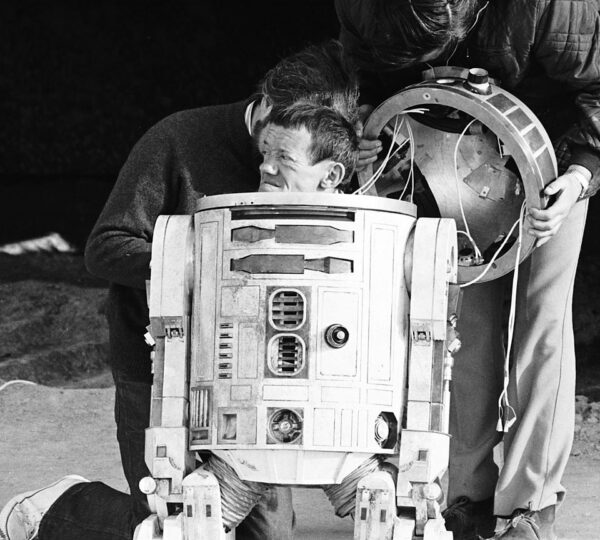
In 1976, Baker was cast as the performer inside R2-D2 for Star Wars: A New Hope. The character itself was little more than a concept on paper: a small, beeping astromech droid with no dialogue, no visible face, and limited mobility.
What transformed R2-D2 into one of the most beloved characters in cinematic history was not just design or sound effects—it was performance.
Inside a heavy, confined costume, often under intense heat and physically demanding conditions, Kenny Baker brought life to a machine. Every tilt, pause, and movement was intentional.
Through subtle timing and physical nuance, he gave R2-D2 a sense of emotion—curiosity, frustration, loyalty, humor. Audiences connected instantly, even though the character never spoke a single word.
That connection was not accidental. Baker understood how to communicate personality through motion alone.
His background in live performance allowed him to make R2-D2 feel reactive and alive, rather than mechanical.
The droid became a constant presence across the original Star Wars trilogy and beyond, silently anchoring scenes with warmth and familiarity.
Despite the global fame that followed, Kenny Baker never allowed success to overshadow his personal values. Away from film sets and fan conventions, his most important role was not on screen—it was at home.
Kenny married Eileen Baker, a woman who shared not only his stature but also his grounded outlook on life.
Like Kenny, Eileen had dwarfism, and together they formed a partnership built on mutual understanding, patience, and resilience.
They knew firsthand what it meant to be underestimated, and they supported each other through the challenges that came with that reality.
When they decided to start a family, medical professionals voiced serious concerns. There were warnings about genetic risks and complications, delivered without certainty and often without sensitivity.
Still, Kenny and Eileen moved forward with quiet determination. They were not chasing expectations or trying to prove a point—they simply wanted to build a family rooted in love.
Against many assumptions, they welcomed two sons, both of whom were born at average height.
Their children grew up healthy, providing a living reminder that genetic outcomes are complex and cannot be reduced to simple predictions.
While Kenny and Eileen never framed their family as a statement, their experience gently challenged widespread misconceptions about disability and inheritance.
The Bakers chose to keep their family life largely private. At a time when novelty stories often overshadowed real people, they resisted being turned into spectacles.
Their home was defined by everyday routines—school, work, laughter, responsibilities, and quiet moments—rather than media attention. Fame remained something that existed outside their front door.
Tragedy struck in 1993, when Eileen Baker passed away after a long illness, at the age of 43. Her death marked a profound turning point in Kenny’s life.
Those close to him described the loss as deeply affecting. The partnership he had relied on for decades was gone, leaving behind grief that never fully faded.
After Eileen’s passing, Kenny Baker withdrew further from public life. While he continued to appear at conventions and interact warmly with fans, his priorities shifted.
He lived more quietly, carrying forward the memory of his wife with dignity and loyalty.
Those who met him during this later period often remarked on his kindness, humility, and willingness to engage sincerely with others.
Despite occasional public misunderstandings about his role in Star Wars, Baker remained proud of his contribution.
He understood that R2-D2 was the result of collaboration—between performers, technicians, and designers—but he also knew the value of his own work.
Without physical performance, the character would never have resonated in the same way.
Kenny Baker passed away on August 13, 2016, at the age of 81. His death prompted tributes from fans and colleagues around the world.
Many reflected not only on his role in one of cinema’s most influential franchises, but also on the dignity with which he lived his life.
His story endures because it speaks to something universal. It is not merely a tale of fame or difference, but of quiet perseverance.
Kenny Baker did not seek to inspire, yet his life naturally did so. He showed that value is not measured by physical scale, that expression does not require words, and that love can flourish even in the face of doubt and loss.
Above all, his life reminds us that some of the most meaningful legacies are built not through spectacle, but through consistency—through showing up, doing the work, caring deeply, and living with integrity.
In a world often obsessed with appearances and expectations, Kenny Baker proved that strength, talent, and humanity often grow strongest where others least expect them.
He stood just 112 centimeters tall—barely more than three and a half feet—and his wife was only slightly taller than him.
From the outside, many people saw only their height and the medical labels attached to it. Doctors warned them early on not to expect an easy path, especially when it came to building a family.
There were cautions, uncertainties, and quiet doubts spoken in clinical tones. Yet none of those warnings were strong enough to stand in the way of love, determination, and the desire to live a full, meaningful life.
This was the reality faced by Kenny Baker, a man whose physical stature never defined the scale of his talent, his resilience, or his impact on the world.
Born on August 24, 1934, in Birmingham, England, Kenny Baker grew up in a working-class family during a time when differences were rarely understood and often misunderstood.
From an early age, it was clear that he would not grow to an average height. He was diagnosed with a form of dwarfism, a condition that shaped his physical body but never limited his ambitions.
In an era with far fewer accommodations and far less awareness, Baker learned quickly that survival depended on adaptability, confidence, and humor.
Long before he became a familiar name to film audiences around the world, Kenny Baker found his place in entertainment through live performance.
As a teenager and young adult, he worked in circuses, carnivals, and traveling shows, environments that demanded stamina, timing, and a strong connection with audiences.
These early years were not glamorous, but they were formative.
On small stages and under temporary tents, Baker learned how to command attention, how to move precisely, and how to turn what others saw as a limitation into a professional strength.
Importantly, these experiences taught him discipline. Circus work required exact movements, physical endurance, and teamwork.
Every performance was a lesson in awareness—of space, of rhythm, and of audience reaction.
These skills would later become essential in a role where expression had to be conveyed without words or facial visibility.
Kenny Baker’s career gradually transitioned into film and television, where his size made him uniquely suited for certain roles during a time when practical effects were the standard.
He appeared in several productions throughout the 1960s and 1970s, including musical films and fantasy projects.
But nothing could have prepared him—or anyone else—for the role that would define his legacy.
In 1976, Baker was cast as the performer inside R2-D2 for Star Wars: A New Hope. The character itself was little more than a concept on paper: a small, beeping astromech droid with no dialogue, no visible face, and limited mobility.
What transformed R2-D2 into one of the most beloved characters in cinematic history was not just design or sound effects—it was performance.
Inside a heavy, confined costume, often under intense heat and physically demanding conditions, Kenny Baker brought life to a machine. Every tilt, pause, and movement was intentional.
Through subtle timing and physical nuance, he gave R2-D2 a sense of emotion—curiosity, frustration, loyalty, humor. Audiences connected instantly, even though the character never spoke a single word.
That connection was not accidental. Baker understood how to communicate personality through motion alone.
His background in live performance allowed him to make R2-D2 feel reactive and alive, rather than mechanical.
The droid became a constant presence across the original Star Wars trilogy and beyond, silently anchoring scenes with warmth and familiarity.
Despite the global fame that followed, Kenny Baker never allowed success to overshadow his personal values. Away from film sets and fan conventions, his most important role was not on screen—it was at home.
Kenny married Eileen Baker, a woman who shared not only his stature but also his grounded outlook on life.
Like Kenny, Eileen had dwarfism, and together they formed a partnership built on mutual understanding, patience, and resilience.
They knew firsthand what it meant to be underestimated, and they supported each other through the challenges that came with that reality.
When they decided to start a family, medical professionals voiced serious concerns. There were warnings about genetic risks and complications, delivered without certainty and often without sensitivity.
Still, Kenny and Eileen moved forward with quiet determination. They were not chasing expectations or trying to prove a point—they simply wanted to build a family rooted in love.
Against many assumptions, they welcomed two sons, both of whom were born at average height.
Their children grew up healthy, providing a living reminder that genetic outcomes are complex and cannot be reduced to simple predictions.
While Kenny and Eileen never framed their family as a statement, their experience gently challenged widespread misconceptions about disability and inheritance.
The Bakers chose to keep their family life largely private. At a time when novelty stories often overshadowed real people, they resisted being turned into spectacles.
Their home was defined by everyday routines—school, work, laughter, responsibilities, and quiet moments—rather than media attention. Fame remained something that existed outside their front door.
Tragedy struck in 1993, when Eileen Baker passed away after a long illness, at the age of 43. Her death marked a profound turning point in Kenny’s life.
Those close to him described the loss as deeply affecting. The partnership he had relied on for decades was gone, leaving behind grief that never fully faded.
After Eileen’s passing, Kenny Baker withdrew further from public life. While he continued to appear at conventions and interact warmly with fans, his priorities shifted.
He lived more quietly, carrying forward the memory of his wife with dignity and loyalty.
Those who met him during this later period often remarked on his kindness, humility, and willingness to engage sincerely with others.
Despite occasional public misunderstandings about his role in Star Wars, Baker remained proud of his contribution.
He understood that R2-D2 was the result of collaboration—between performers, technicians, and designers—but he also knew the value of his own work.
Without physical performance, the character would never have resonated in the same way.
Kenny Baker passed away on August 13, 2016, at the age of 81. His death prompted tributes from fans and colleagues around the world.
Many reflected not only on his role in one of cinema’s most influential franchises, but also on the dignity with which he lived his life.
His story endures because it speaks to something universal. It is not merely a tale of fame or difference, but of quiet perseverance.
Kenny Baker did not seek to inspire, yet his life naturally did so. He showed that value is not measured by physical scale, that expression does not require words, and that love can flourish even in the face of doubt and loss.
Above all, his life reminds us that some of the most meaningful legacies are built not through spectacle, but through consistency—through showing up, doing the work, caring deeply, and living with integrity.
In a world often obsessed with appearances and expectations, Kenny Baker proved that strength, talent, and humanity often grow strongest where others least expect them.